
Fire Safety: Know Your Extinguisher
Sample eLearning module
Adaptive Path Branching Scenario | Articulate Storyline 360 Portfolio Sample
Can you identify the right extinguisher before the fire spreads?
This Storyline 360 portfolio sample demonstrates adaptive path branching, scenario-based assessment, and learner-responsive routing, designed for a zero-error performance domain.
Note: This is a partial-build portfolio sample. It is a purposeful demonstration of adaptive learning design, not a full course build. It is designed to show how I think, how I design, and what is possible when branching is used intentionally.
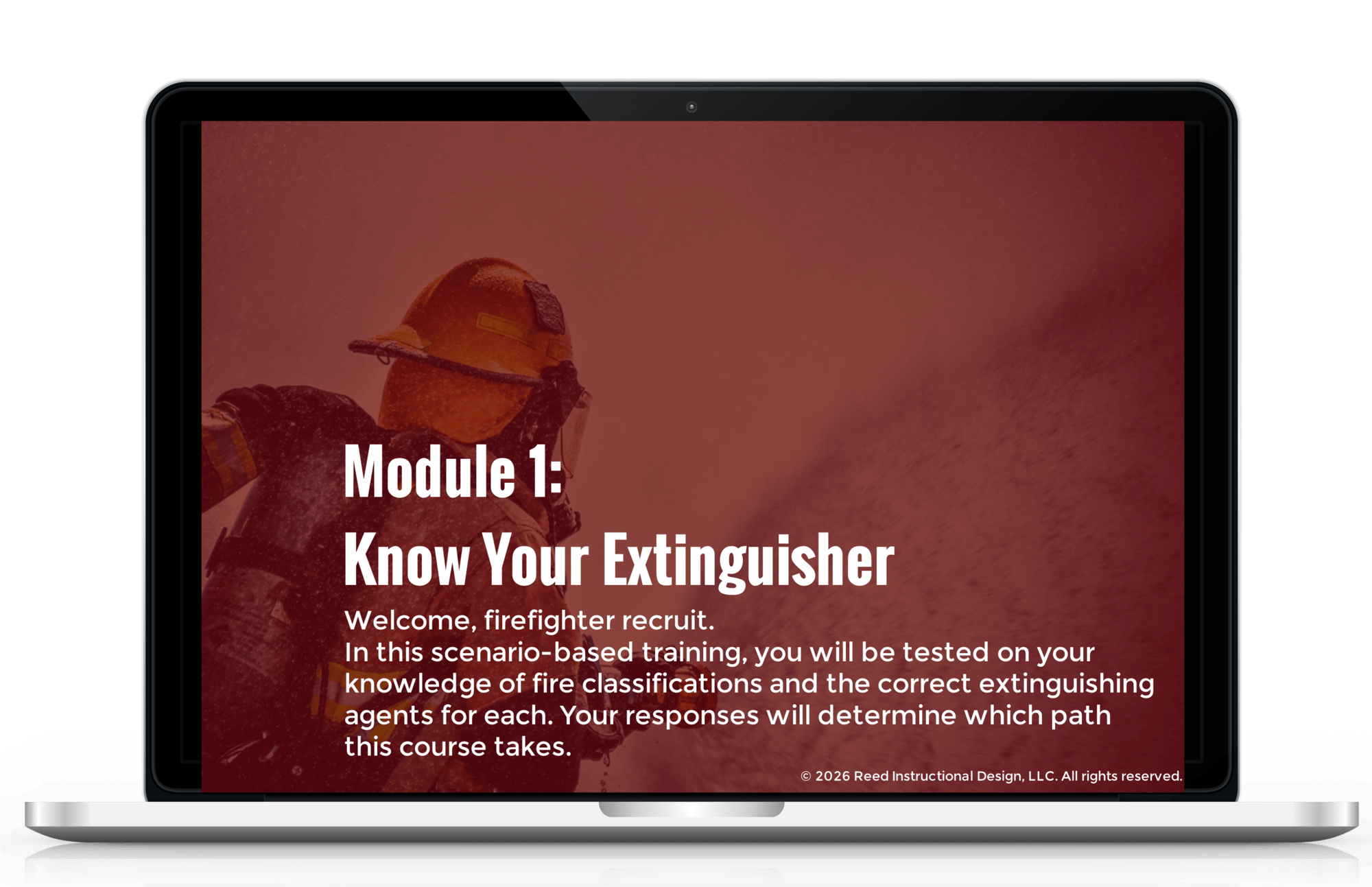
Audience
Firefighter recruits and safety personnel. Learners operating in a zero-error domain where the wrong agent choice can escalate a fire rather than suppress it.
Tools used
Articulate Storyline 360, Piktochart, Claude, Envato, & Canva
My Responsibilities
End-to-end instructional design and eLearning development, including action mapping, storyboarding, branching architecture, and full build in Articulate Storyline 360.
The Problem
Fire extinguisher selection is a life-safety skill and one where the stakes of a wrong choice are immediate and severe. Classroom instruction can build foundational knowledge about fire classifications and agent types, but knowledge alone does not translate to reliable performance under pressure.
For this portfolio sample, the performance problem is framed around a realistic gap: learners who can recite classification rules in a test environment often struggle to apply that knowledge accurately when confronted with a real scenario. The cost of hesitation or misidentification is not just a failed assessment; it is an escalated fire.
A traditional quiz-based approach would measure recognition, not decision-making. What was needed was a design that placed learners inside a scenario and required them to act, with consequences that reflected the real-world stakes of getting it wrong.
The Solution
I designed a short, scenario-driven eLearning module that presents learners with three realistic fire situations and requires them to select the correct extinguishing agent for each. The module uses Storyline's built-in Quiz.ScorePercent variable to silently evaluate cumulative performance and route learners to one of two paths, without interrupting the experience with a visible score.
Learners who demonstrate mastery across all three scenarios are advanced to a primary path with extended application content. Learners who fall below the threshold are routed to a foundational remediation path before both groups reconverge at a shared summary. Learners who score 67% or higher advance to the primary path. The final passing standard is set at 100%, appropriate for a domain where partial knowledge is not acceptable.
The design prioritizes decision practice over information delivery. Each scenario requires the learner to read the situation, evaluate the options, and commit to a choice, reinforcing the connection between scenario recognition and correct agent selection.
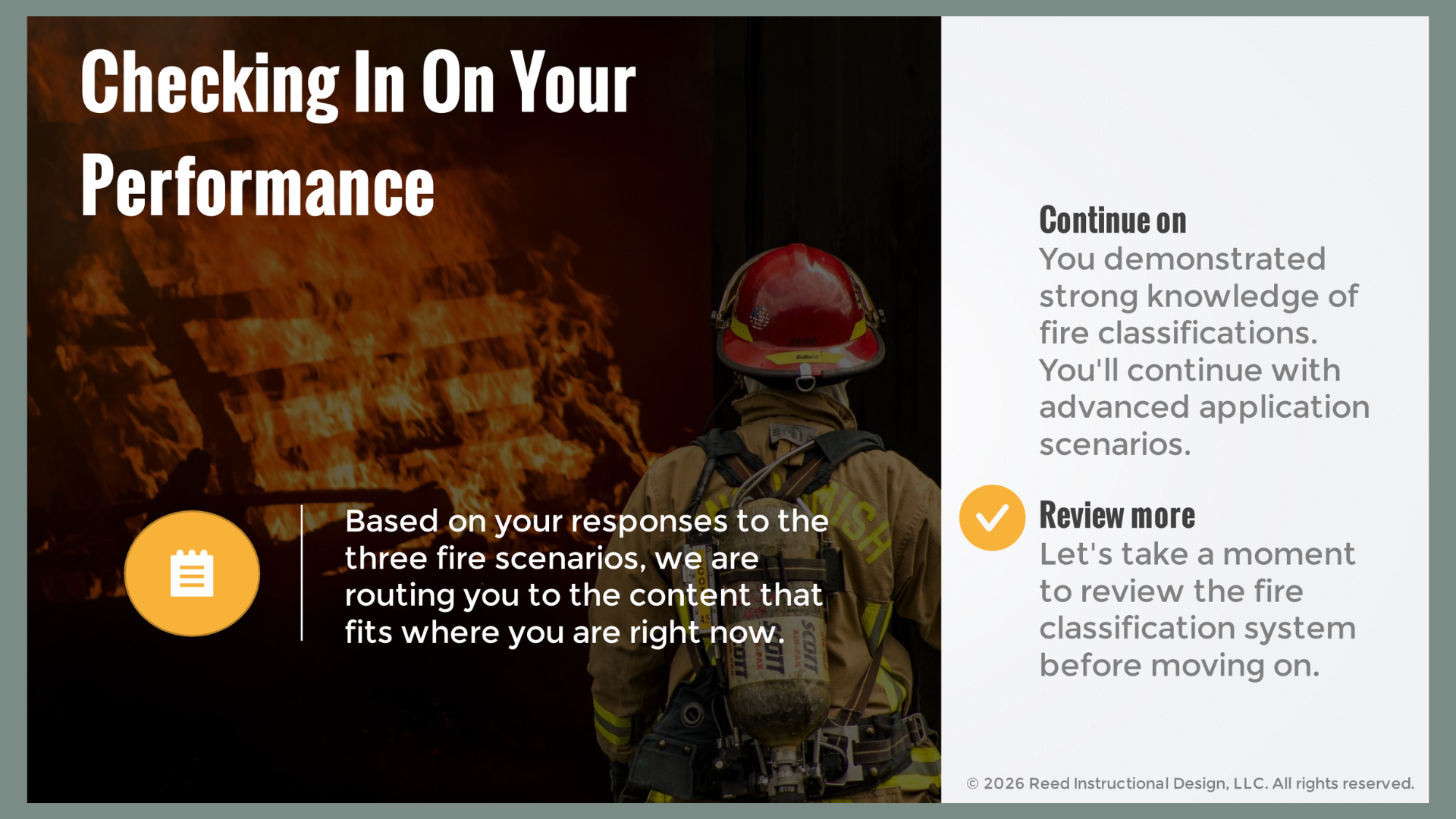
This slide illustrates the adaptive routing moment. When a learner scores below the threshold, they are directed to the remediation pathway. The transition slide can be made visible to the learner or hidden entirely, depending on the design intent.
My Process
I approached this project using an analysis-first design process. I began by identifying the specific performance gap. This was not a knowledge deficit but an application gap. I worked backward from the required performance standard to determine what practice would most effectively close it.
From there, I built an action map to identify the decisions that mattered most, drafted a text-based storyboard to blueprint the full branching structure, established a style guide to define the visual language, and developed wireframes before building the final product in Storyline 360.
Each stage was designed to serve the next. The action map informed the storyboard, the storyboard informed the style guide and wireframes, and those informed the build. The result is a tight, purposeful sample where every design decision connects back to the performance objective.
Action Map
I started with action mapping to anchor the design in observable performance, not content coverage. The central goal was clear: given three scenario-based fire situations, learners must select the correct extinguishing agent for each fire class with 100% accuracy before advancing to the next module. From there, I identified the three highest-priority decisions a learner must make on the job and structured the module around practicing each one.
Action mapping kept the design lean. Rather than building a comprehensive overview of fire science, I focused the content exclusively on what the learner needs to do. Classify the fire. Select the appropriate agent. Each scenario was designed to require exactly that decision.
.png "Untitled design (1)")
Text-Based Storyboard
With the action map complete, I developed a full text-based storyboard to blueprint every slide in the module. Each slide was documented with narration, visual descriptions, programming logic, and branching behavior. The storyboard served as the single source of truth for the entire build.
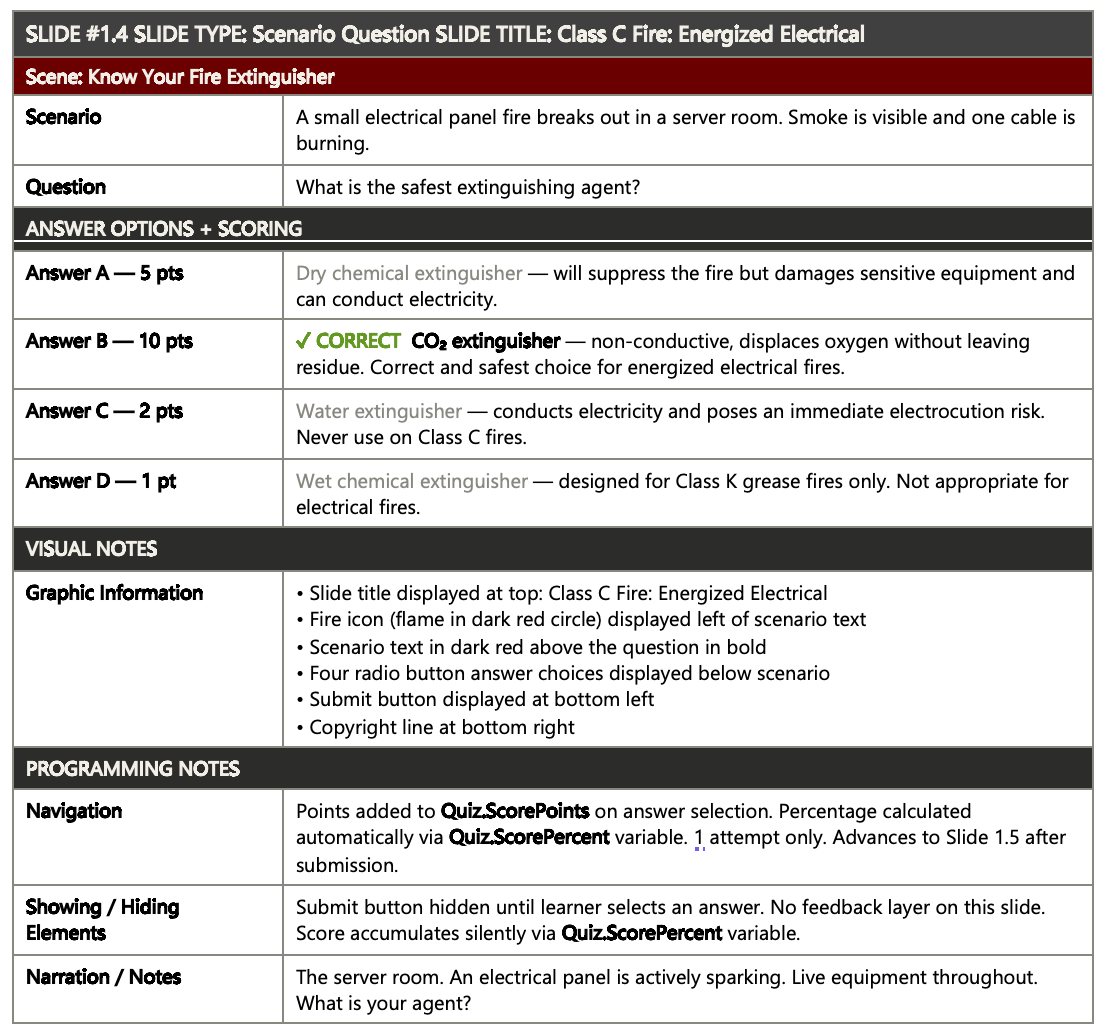
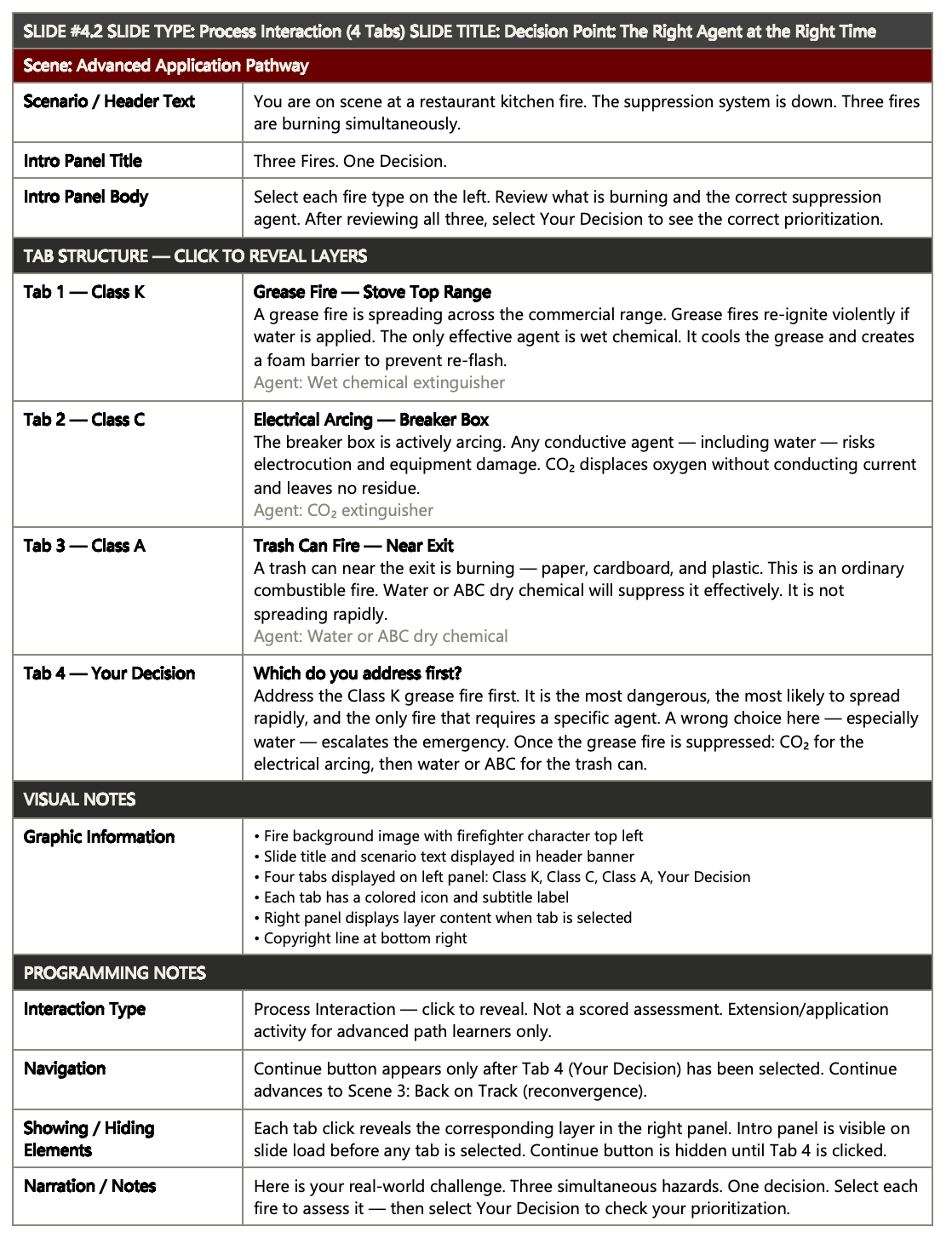
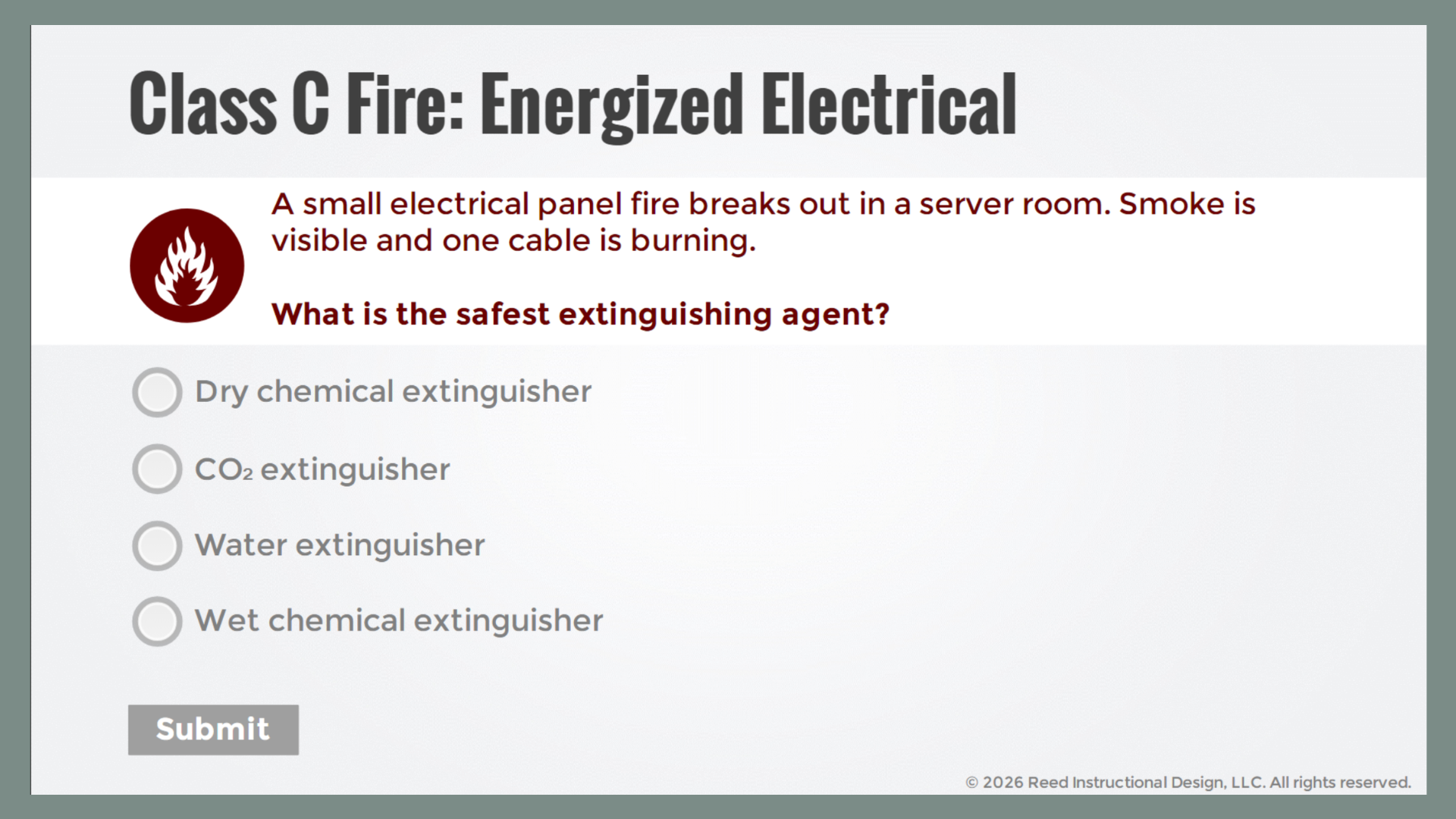
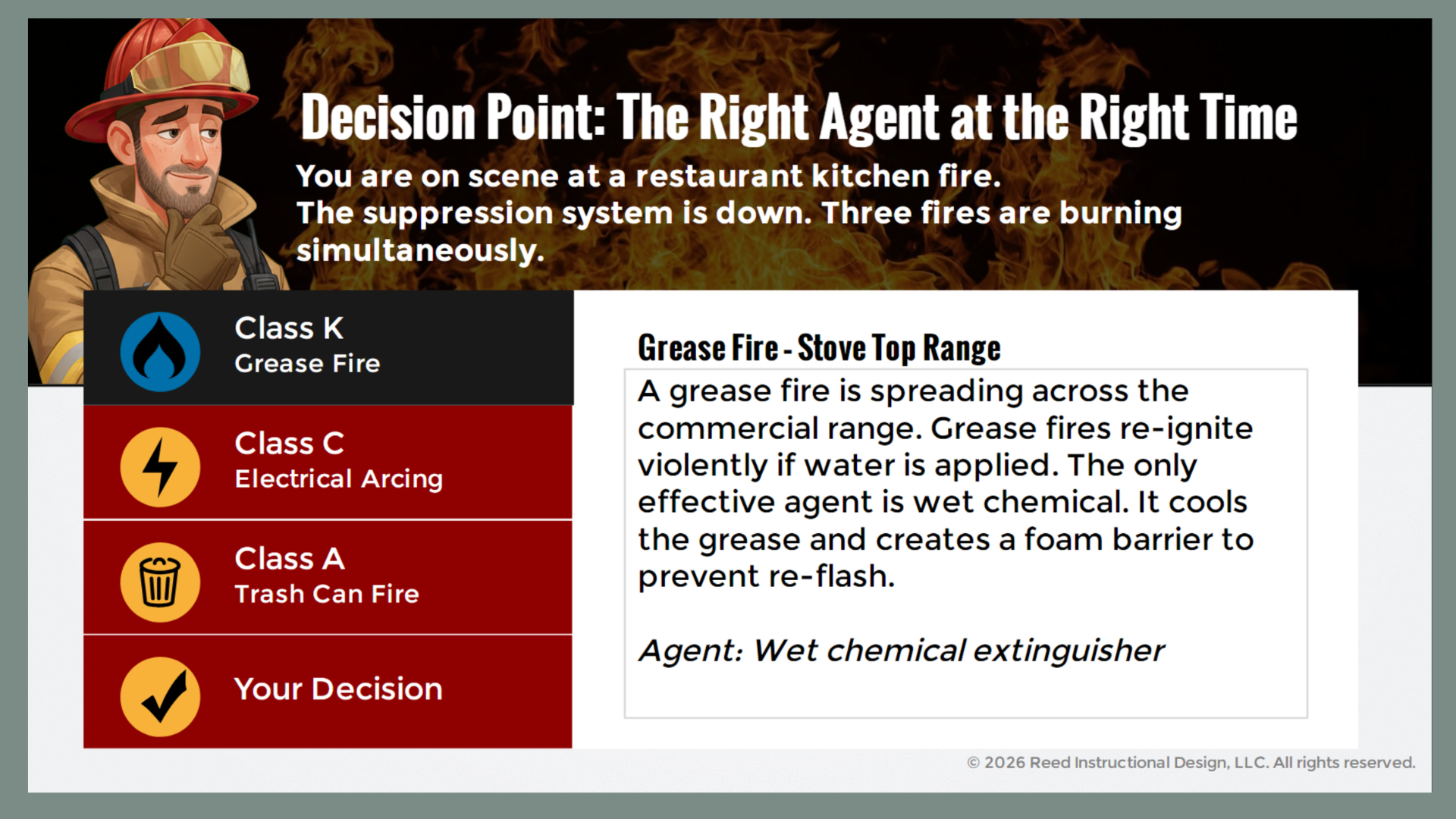
Each scenario question was written to place the learner inside a realistic field situation. The screenshots above show the storyboard document alongside the finished Storyline slides, illustrating how the blueprint translated directly into the build.
What you see here represents the full adaptive pathway. A learner responds to scenario-based quiz questions. Based on their cumulative performance, they are routed to one of two experiences. Strong performers advance to the Decision Point activity, a multi-hazard application scenario that challenges them to prioritize across three simultaneous fire classes. Learners who need additional support are routed to the remediation path, which builds the foundational knowledge first and then asks them to practice agent selection through an interactive review activity. Both paths reconverge at the same summary before the module closes.
Having the full branching architecture documented in the storyboard before opening Storyline made the build faster, cleaner, and significantly easier to quality review.
Style Guide
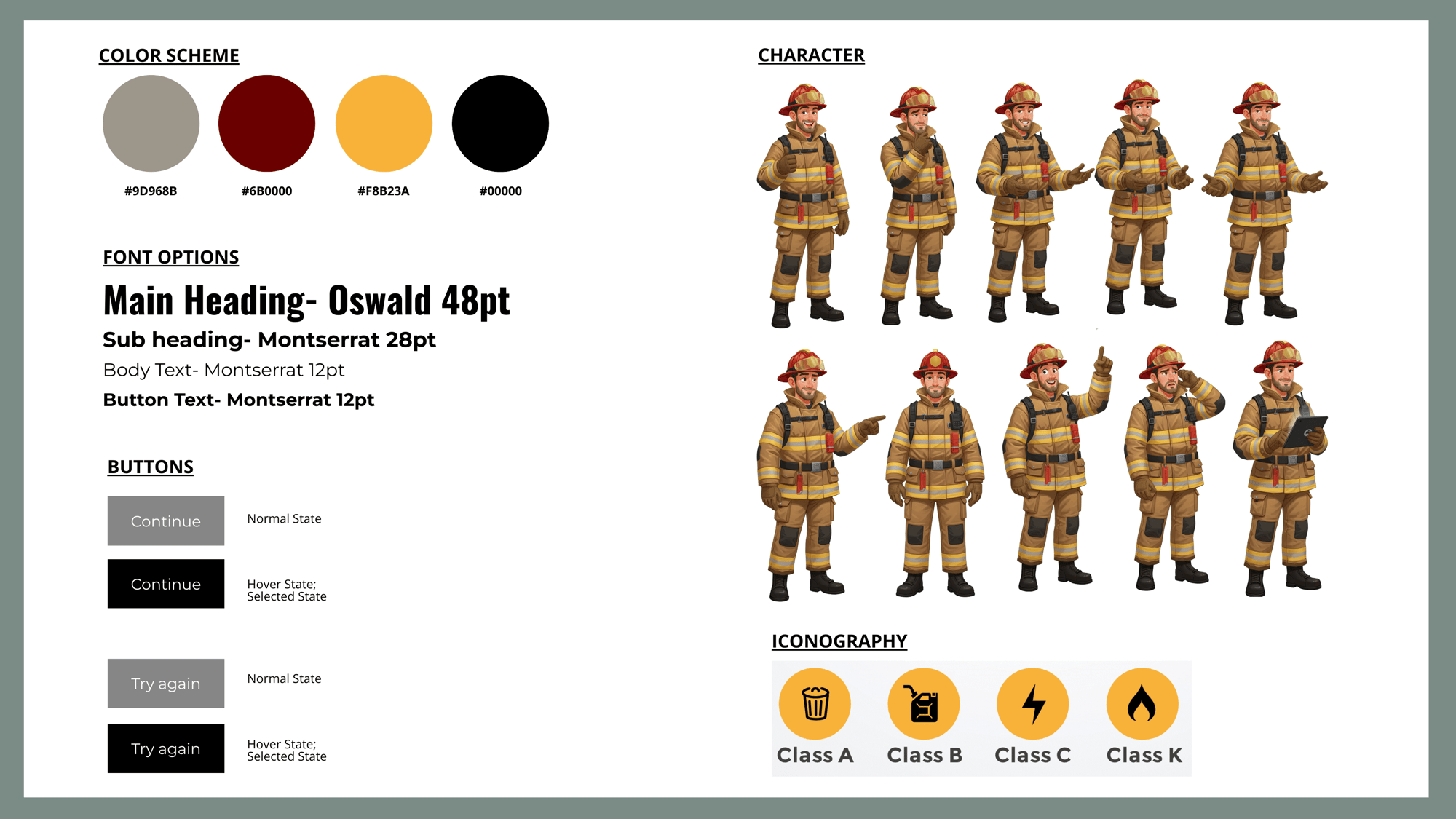
Before building, I established a style guide to define the visual language of the module. Every decision including color, typography, button behavior, character selection, and iconography was documented before a single slide was built.
The color palette centers on four values: Light Gray (#9D968B) for supporting elements, Dark Red (#6B0000) for urgency and danger cues, Yellow (#F8B23A) for key actions and correct response indicators, and Black (#000000) for primary text. Each color was selected to align with the subject matter and reinforce the stakes of the content without relying on decoration.
Typography follows a clear hierarchy. Main headings use Oswald at 48pt for bold, immediate visual impact. Subheadings use Montserrat at 28pt, body text at 12pt, and button text at 12pt. This keeps the typographic system clean and consistent across all slides.
Button states are documented for both Continue and Try Again. Normal state displays in gray. Hover and selected state displays in black. This ensures learner feedback is visually clear and consistent throughout the experience.
The firefighter character is shown in nine poses, giving the build flexibility to match character expression and posture to the tone of each slide. Iconography uses four yellow circle icons, one per fire class, providing a consistent and instantly recognizable visual system across the Agent Selection and Decision Point activities.
Defining these standards before development ensured visual consistency across every slide and makes future updates or handoff to another developer clean and straightforward.
Visual Mockups & Wireframes
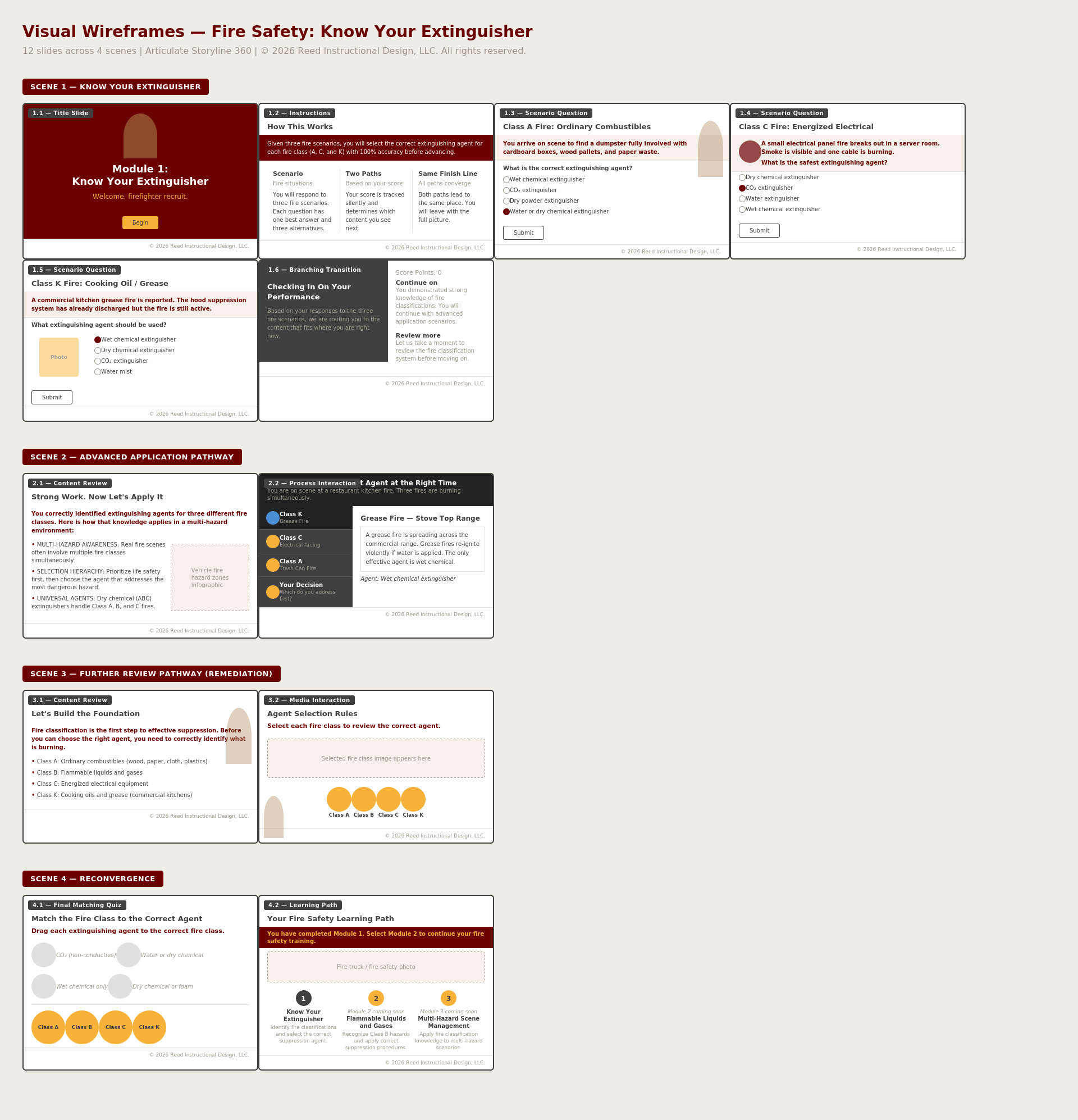
With the storyboard and style guide in place, I developed wireframes for each slide type in the module before opening Storyline. Wireframing allowed me to lock in layout decisions including text placement, button positioning, character placement, and content hierarchy before investing time in the full build.
The wireframe set covers all four scenes: the Know Your Extinguisher assessment sequence, the Advanced Application Pathway, the Further Review Pathway, and the Reconvergence. Each wireframe maps directly to a storyboard slide, making the relationship between blueprint and build explicit and easy to follow.
.png?width=1920&height=1080&name=Untitled%20design%20(2).png)
Interactive Prototype & Full Development
Before full development, I built a functional prototype in Articulate Storyline 360 to validate the branching logic, test the Quiz.ScorePoints routing, and confirm the learner experience felt cohesive. Testing at this stage surfaced a key design clarification: the branching threshold and the passing score are intentionally separate parameters. The threshold determines which learning path a learner receives. The passing score determines whether they completed the module successfully. A learner can be routed to the Further Review Pathway and still ultimately pass after completing that path.
With the prototype validated, I moved into full development. The module is built across four scenes — Know Your Extinguisher, the Advanced Application Pathway, the Further Review Pathway, and Reconvergence — and includes scenario-based quiz questions, a four-tab Process Interaction activity, a media interaction with click-to-reveal fire class content, a drag-and-drop matching quiz, and a learning path slide that positions the learner for continued training across three modules.
Favorite Features
Silent Adaptive Routing: The branching in this module is invisible to the learner. There is no score displayed, no you passed or you need remediation message. The Quiz.ScorePoints variable accumulates silently across three questions, and learners are routed to the appropriate path without interruption. The design prioritizes learning continuity over mechanical feedback.
The Branching Reveal Slide: Rather than an abrupt invisible jump, I added a Checking In On Your Performance transition slide that acknowledges the routing in plain language without showing a score or labeling the learner. It tells the learner their path is adapting to their performance and frames both options positively. This preserves motivation while making the adaptive design visible and intentional.
Weighted Scoring With Built-in Quiz Variables: The adaptive routing uses Storyline's built-in Quiz.ScorePercent variable --- no custom variables, no complex trigger logic. The scoring is weighted by answer quality rather than binary correct or incorrect (10, 5, 2, or 1 point per question), which gives the branching threshold real differentiation. Learners scoring 67% or higher advance to advanced application content, while those below receive foundational remediation. It is an efficient solution that accomplishes sophisticated branching with the tools already available.
Zero-Error Standard: Setting the passing score at 100% was a deliberate design decision. In fire safety, partial knowledge is not an acceptable learning outcome. The mastery standard is built into the architecture of the module, not just the results slide, and that alignment between design intent and system configuration matters.
Your Fire Safety Learning Path: Rather than ending the module at a static completion screen, the reconvergence slide positions the learner within a broader curriculum.
Results & Takeaways
This module is a portfolio sample, not a deployed training solution. There are no learner completion rates, post-assessment scores, or performance trend data to report and none will be fabricated.
What this sample demonstrates is a full design process, executed with intentionality: a performance-focused analysis, a branching architecture grounded in real adult learning principles, a 100% mastery standard appropriate to the domain, and a build that uses Storyline's native tools efficiently and purposefully.
It also demonstrates a design philosophy relevant to compliance and high-risk training environments. An organization cannot afford 80% proficiency when the remaining 20% is the gap that causes injury. Adaptive design is not just a learner experience decision. It is a risk management decision. This sample illustrates that it is possible to drive learners toward 100% proficiency while supporting their individual learning journey through intelligent, responsive design.
Sustained competency and on-the-job application require evaluation beyond the eLearning event itself, including observation, performance data, and ongoing reinforcement aligned with Kirkpatrick's Levels 3 and 4. This module is the starting point, not the finish line.
The takeaway is not a metric. It is a methodology and a clear picture of how I think about design from the first question through the final slide.